
31
RECTANGULAR COÖRDINATES
WE WILL BEGIN with vocabulary.
First, a coördinate. A coördinate is a number. It labels a point on a line.

The coördinate 0 is called the origin of coördinates. Distances to the right of 0 are labeled with positive coördinates: 1, 2, 3, etc. Distances to the left are labeled with negative numbers: −1, −2, −3, etc. Each coördinate is the "address" of a distance and direction from 0.
A coördinate axis is a line with coördinates.
Now, to label a point in a plane (a flat surface), we will need more than one coördinate axis, and so we place a second at right angles to the first.
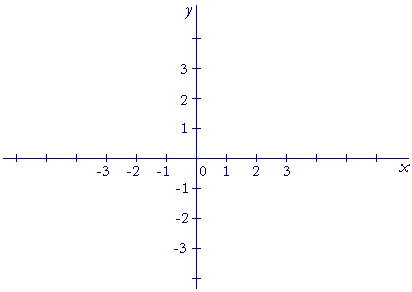
Distances above the origin will have positive coördinates; distances below, negative coördinates.
Those axes are called rectangular coördinate axes, because they are at right angles to one another. The coördinates on them are called rectangular coördinates. They are also called Cartesian coördinates, after the 17th century philosopher and mathematician René Descartes; for he was one of the first to realize the possibility of solving problems of geometry by means of algebra with the coördinates. Hence we have the name coördinate geometry or, as it is often called, analytic geometry.
Rectangular coördinates are an ordered pair, (x, y).
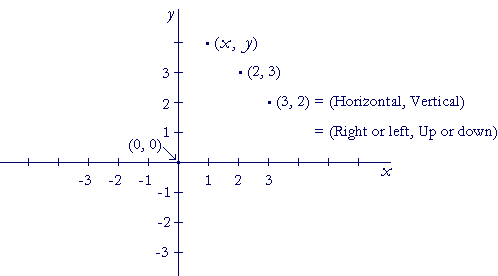
The pair (2, 3)—over 2 and up 3—labels a different point than (3, 2): over 3 and up 2. The horizontal coördinate—Right or left—is always entered first. The vertical coördinate—Up or down—is always entered second. For that reason, (3, 2) is called an ordered pair.
The coördinates of the origin are (0, 0). We do not move right or left and we do not move up or down. We will see that 0 is an extremely important coördinate. It means that the point is on one of the axes.
The horizontal axis is called the x-axis, and the vertical axis is called the y-axis. The first coördinate, then, is called the x-coördinate; the second, the y-coördinate. We always write (x, y).
Finally, the coördinate axes divide the plane into four quadrants:
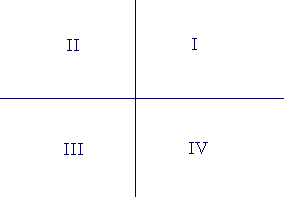
The first, the second, the third, and the fourth. We label the quadrants counter-clockwise.
Problem 1. Coördinate 0.
a) On the x-axis, what is the value of every y-coördinate? 0
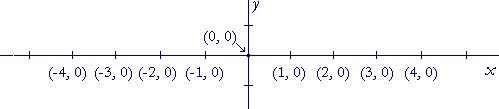
On the x-axis, we don't move up or down. At every point, y = 0.
b) On the y-axis, what is the value of every x-coördinate? 0
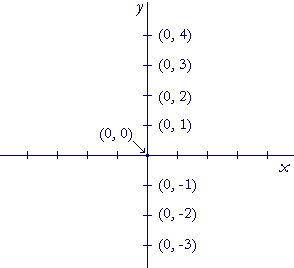
On the y-axis, we don't move right or left. At every point, x = 0.
c) Where is the y-coördinate always 0? On the x-axis.
d) Where is the x-coördinate always 0? On the y-axis.
Problem 2.
a) Where is the x-coördinate always 2?
On the vertical line 2 units to the right of the origin.
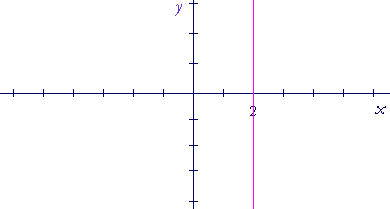
In fact, we say that that vertical line is the graph of the equation
x = 2.
That is the equation, because at every point of that line, the x-coördinate is 2.
b) Where is the y-coördinate always −3?
On the horizontal line 3 units below the origin.
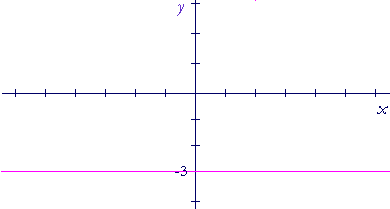
That line is called the graph of y = −3. And y = −3 is called the equation of that line.
Problem 3. In which quadrant does each point lie? Or is it on an axis; if so, which axis?
| a) | (2, −3) Fourth | b) | (−4, 2) Second | |
| c) | (0, −5) On the y-axis. | d) | (−3, −1) Third | |
| e) | (5, 0) On the x-axis. | f) | (−6, 9) Second | |
| g) | (0, −4) On the y-axis. | h) | (−4, 0) On the x-axis. | |
| i) | (−1, −1) Third | j) | (0, 6) On the y-axis. | |
| k) | (−1, 0) On the x-axis. | l) | (0, 1) On the y-axis. | |
| m) | (5, −2) Fourth | n) | (−5, 0) On the x-axis. | |
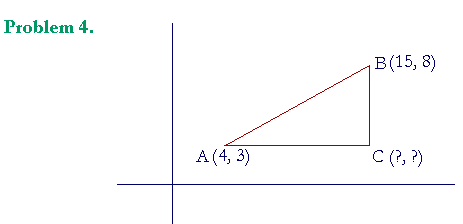
The extremities of a straight line AB have coördinates (4, 3) and (15, 8), and that line is the hypotenuse of a right triangle ACB, whose sides are parallel to the axes.
Name the coördinates of the right angle at C.
C has the same x-coördinate as B. Therefore its x-coördinate is 15. And C has the same y-coördinate as A. Therefore its y-coördinate is 3. The coördinates at C are (15, 3).
Straight lines
An actually infinite straight line is a line that has no extremities—no endpoints.

Obviously, such a line is a mental object---an idea---only. It is not possible to witness one or draw one.
(Similarly, it is not possible to produce an actually infinite sequence of digits, as this symbol, "0.36363636. . . ," is meant to signify. That, too, is a purely mental object; it is an idea.)
And so the student should be advised that when writers use the expression "straight line" these days, they invariably mean an actually infinite line. Hence they refer to any finite line, with its two extremities, as a line segment. They imagine that every finite straight line—even the side of a square you might draw—is a segment of an actually infinite line.
That is what we are taught, and so we think that's mathematics—that's the way things are. We do not realize that it is a human invention.
In classical plane geometry a straight line has two extremities.

It is potentially infinite in the sense that we may extend it in either direction for as far as we please. In practice that is all we ever require.
A line—length with no width—is an idea in the first place. As an idea, it clearly exists. But should that be sufficient for mathematics? Should we not be able to make an image of it in the physical world?
Euclid, in his first Postulate, has answered that. He has asked us to grant that we can do the following:
To draw a straight line from any point to any point.
In other words, he asks us to regard what we have drawn to be a straight line. We will have brought a symbol for that idea into this world.
See First Principles of Euclidean Geometry, Commentary on the Definitions.
A ray is also a mental object. It is the idea of a straight line with one extremity.


Next Lesson: The Pythagorean distance formula
Please make a donation to keep TheMathPage online.
Even $1 will help.
Copyright © 2021 Lawrence Spector
Questions or comments?
E-mail: teacher@themathpage.com