
Lesson 7 Section 2
THE MEANING OF SUBTRACTION
Mental calculation
Subtract by the ending
Knowing the endings in addition (Lesson 4) becomes skill in subtraction. For example, to find the number we must add to 8 to get 32 --
32 − 8
-- let us ask:
8 + ? ends in 2 ?
8 + 4 ends in 2 -- because 8 + 4 is 12.
Therefore, 32 − 8 will also end in 4. It must be 24. The answer falls in the previous decade.

In fact, whenever we take an 8 from a 2, the answer always ends in 4.
42 − 8 = 34
62 − 8 = 54
92 − 8 = 84
The answers fall in the previous decade. These are problems you should not have to write down.
Example 1. 41 − 9
Solution. 9 + ? ends in 1.
Solution. 9 + 2 ends in 1, because 9 + 2 is 11. Therefore,
41 − 9 = 32
Example 2. You could know
84 − 8 = 76,
because 8 + 6 ends in 4.
To summarize:
| 3. | How can we find the difference by how it must end? |
| 84 − 8 = 76 | |
| Decide what number you must add to the smaller number to get the ones digit of the larger. | |
*
Next, how can we find the difference between two-digit numbers? First:
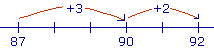
| 4. | How can we find the difference between a number in one decade and a number in the previous decade? |
| 92 − 87 | |
|
|
|
Add to the smaller number to complete a 10. Then add the ones of the larger number. |
|
| "87 plus 3 is 90, plus 2 is 92." | |
| 92 − 87 = 5. | |
Example 3. 52 − 46
Say only, "4 + 2 is 6."
That is, 46 plus 4 is 50, plus 2 is 52.
Example 4. 57 + ? = 65
"3 + 5 is 8."
Example 5. 23 − 18
"2 + 3 is 5."
These are problems that you should not have to write, and certainly should not require a calculator.
Next, let's look at two-digit numbers that are farther apart.
42 + ? = 96
How to do it? First add enough tens to get to the 90's.
"42 + 50 is 92, plus 4 is 96."
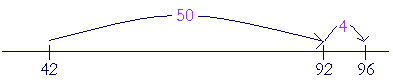
42 + 54 = 96.
| Example 6. | 25 + ? = 87 |
| "25 + 60 is 85, plus 2 is 87." | |
That is, 25 + 62 = 87.
Finally, here is the case where the ones digit of the smaller number is greater.
27 + ? = 80
First consider this case where we're going to a multiple of 10. In this case, add to get to the previous decade -- the 70's.
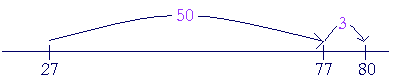
"27 plus 50 is 77, plus 3 is 80."
27 + 53 = 80.
In practice, say only,
"50 + 3 is 53."
| Example 7. | 36 + ? = 90 |
| "50 plus 4 is 54." | |
| That is, | 36 + 50 is 86, plus 4 is 90." |
| Example 8. | 38 + ? = 60 |
| "20 plus 2 is 22." | |
(38 plus + 20 is 58, plus 2 is 60.)
Now say that the larger number is not a multiple of 10.
38 + ? = 64
Again, add to 38 to get to the previous decade. But in this case we know that the difference will end in 6 -- the ones digit will be a 6. (8 + 6 ends in 4.)
38 + 26 = 64.
38 plus 20 is 58, plus 6 is 64.
To summarize:
| 5. | How can we find the difference of two-digit numbers when the ones digit of the smaller number is greater? |
| 61 − 23 = ? | |
| 23 + ? = 61 | |
|
Decide how the difference will end. Then add to get to the previous decade. |
|
Example 9. 23 + ? = 61
Solution. The difference will end in 8. (3 + 8 ends in 1.) Therefore,
23 + 38 = 61.
(23 plus 30 is 53, plus 8 is 61.)
| Example 10. | 55 + ? = 82 |
| "55 + 20 is 75. 27." | |
The difference ends in 7.
At this point, please "turn" the page and do some Problems.
or
Continue on to the next Section.
Introduction | Home | Table of Contents
Copyright © 2021 Lawrence Spector
Questions or comments?
E-mail: teacher@themathpage.com