
Lesson 18 Section 2
RATIO AND PROPORTION
"Out of"
| 4. | What does "out of" indicate? |
| 3 out of 5 | |
| The ratio of a smaller number to a larger, of a part to the whole. | |
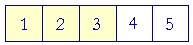
This illustrates 3 out of 5: the ratio of the part, 3, to the whole, 5. The part is three fifths of the whole. (Here, "part" refers to whatever is less than the whole.)
"Out of" is often how fractions are introduced: as ratios but with fractional symbols. A fraction, however, is a number we need for measuring. "Out of" does nothing to explain where the number 3/5 belongs on the number line. See Lesson 20.
Example 1. In a class of 40 students, 3 out of 5 got B. How many students got B?
Solution 1. Complete this proportion:
3 : 5 = ? : 40.
(3 out of 5 is how many out of 40?)
"5 goes into 40 eight times. Eight times 3 is 24."
24 students got B.
That should be a simple mental calculation. Simply see that 40 is eight 5's.
Notice that "3 out of 5" -- a smaller number out of a larger -- makes sense. It would make no sense to say "5 out of 3."
"3 out of 5" means: For every 5, there are 3.

If there are two 5's,

there will be two 3's. If there are three 5's, there will be three 3's.

And so on. Therefore, if there are eight 5's, there will be eight 3's. This is the theorem of the same multiple.
Solution 2. To say that 3 out of 5 got B, is to say that three fifths of the 40 students got B. One fifth of 40 is 8. Therefore, three fifths are 3 × 8 = 24. Lesson 15.
Example 2. In a recent survey, 7 out of 10 people responded Yes. If 280 people responded Yes, then
a) how many people were surveyed? b) how many responded No?
Solution. In this Example, 280 is the part that responded Yes. It corresponds to 7.
7 : 10. = 280 : ?
Now, 280 is 40 × 7. Therefore the missing term is 40 × 10.
7 : 10 = 280 : 400.
400 is the whole number of people surveyed.
b) Since 280 is the number that responded Yes, then the difference,
400 − 280,
b) will be the number that responded No.
400 − 280 = 120.
Percent: Out of 100
Percent problems often involve the expression "out of," because percent is out of, or how many for each, 100. Therefore any number out of 100 is that percent.
Example 3. 8 out of 100 is what percent?
Answer. 8%.
Note: When we consider the ratio of a smaller number to 100, then we may say "out of." But when we have the ratio of a larger number to 100 -- 200 to 100 -- then 200 "out of" 100 make no sense. In that case, we must say "for each."
Example 4. 250 for each 100 is what percent?
Answer. 250%.
Example 5. 8 out of 25 students got B. What percent got B?
Answer. Percent is out of 100. Therefore, let us complete this proportion:
8 : 25 = ? : 100.
"8 out of 25 is equal to how many out of 100?"
Now, 4 × 25 = 100. Therefore the missing term will be 4 × 8.
8 : 25 = 32 : 100.
But 32 out of 100 is 32%. And since that is equal to 8 out of 25, then 8 out of 25 is also 32%.
32% of the students got B.
Note that the following questions mean the same:
8 out of 25 is what percent?
8 is what percent of 25?
Finding a percent by making the fourth term 100 is called the method of proportions. It is another instance of The Rule of Three.
| 5. | How do we find a Percent by the method of proportions? |
| 1st : 2nd = Percent : 100. | |
| Make the 4th term of a proportion 100. The 3rd term is then the Percent that the 1st is of the 2nd. | |
We will go into this more in Lesson 30.
Example 6. 18 is what percent of 200?
Solution. Proportionally,
18 : 200 = ? : 100.
Now, to go from 200 to 100, we have to divide by 2. Therefore, we have to divide 18 by 2, also:
18 : 200 = 9 : 100.
18 is 9% of 200.
Example 7. 18 is what percent of 50?
Solution. Proportionally,
18 : 50 = ? : 100.
Here, to go from 50 to 100, we have to multiply by 2. Therefore, we have to multiply 18 by 2.
18 : 50 = 36 : 100.
18 is 36% of 50.
We see that when the 2nd term is smaller than 100, we have to multiply it. But when the 2nd term is more -- Example 6 -- we have to divide it.
Example 8.
a) We know that 6% is 6 out of 100. .6% is 6 out of how many?
Answer. .6% is
.6 out of 100.
Therefore on multiplying both terms by 10:
.6 out of 100 = 6 out of 1000.
b) .06% is 6 out of how many?
Answer. On multiplying both terms by 100,
.06 out of 100 = 6 out of 10,000.
Percent continues in Lesson 28.
At this point, please "turn" the page and do some Problems.
or
Introduction | Home | Table of Contents
Copyright © 2021 Lawrence Spector
Questions or comments?
E-mail: teacher@themathpage.com