
8
MORE RULES
FOR
DERIVATIVES
The derivative of an inverse function
The quotient rule
The following is called the quotient rule:
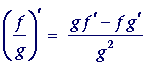
"The derivative of the quotient of two functions is equal to
the denominator times the derivative of the numerator
minus the numerator times the derivative of the denominator
all divided by the square of the denominator."
For example, accepting for the moment that the derivative of sin x is cos x (Lesson 12):
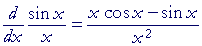
| Problem 1. Calculate the derivative of | x2 sin x |
. |
To see the answer, pass your mouse over the colored area.
To cover the answer again, click "Refresh" ("Reload").
Do the problem yourself first!
| sin x· 2x − x2 cos x sin2x |
Problem 2. Use the chain rule to calculate the derivative of
| sin2x x3 |
. |
|
x3· 2 sin x cos x − sin2x· 3x2 x6 |
= |
x2 sin x(2x cos x − 3 sin x) x6 |
| = |
sin x(2x cos x − 3 sin x) x4 |
|
| Problem 3. Calculate the derivative of | x2 − 5x − 6 2x + 1 |
. |
| (2x + 1)(2x − 5) − (x2 − 5x − 6)· 2 (2x + 1)2 |
= | 4x2 − 8x − 5 − 2x2 + 10x + 12 (2x + 1)2 |
| = | 2x2 + 2x + 7 (2x + 1)2 |
|
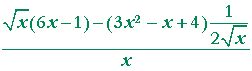
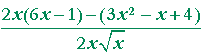
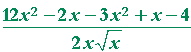
| Problem 4. Calculate the derivative of | 3x2 − x + 4 |
. |
See the Example, Lesson 6, and Lesson 22 of Algebra.
 |
= |  |
| = |  |
|
| = |  |
|
Proof of the quotient rule
| THEOREM. | 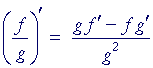 |
Proof. Since g = g(x), then
| d dx |
1 g |
= | d dg |
1 g |
· | dg dx |
= − | 1 g2 |
g' |
according to the chain rule, and Problem 4 of Lesson 5.
Therefore, according to the product rule (Lesson 6),
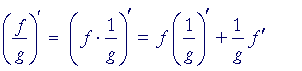
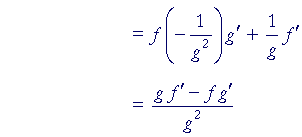
This is the quotient rule, which we wanted to prove.
Implicit differentiation
Consider the following:
x2 + y2 = r2
This is the equation of a circle with radius r. (Lesson 17 of Precalculus.)
Let us calculate  .
.
To do that, we could solve for y and then take the derivative. But rather than do that, we will take the derivative of each term. As for y2, we consider it implicitly a function of x, and therefore we may apply the chain rule to it. Then we will solve for .
| d dx |
x2 | + | d dx |
y2 | = | d dx |
r2 |
| 2x + 2y | dy dx |
= | 0 | |||
| dy dx |
= | − | x y |
. | ||
This is called implicit differentiation. We treat y as a function of x and apply the chain rule. The derivative that results generally contains both x and y.
Problem 5. 15y + 5y3 + 3y5 = 5x3. Calculate y'.
| 15y' + 15y2y' + 15y4y' | = | 15x2 |
| y'(1 + y2 + y4) | = | x2 |
| y' | = |
x2 1 + y2 + y4 |
| Problem 6. | 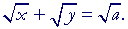 |
Calculate y'. |
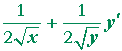 |
= | 0 |
 |
= |  |
| y' | = |  |
Problem 7.
a) In this circle,
x2 + y2 = 25,
a) what is the y-coördinate when x = −3?
y = 4 or −4. For,
(−3)2 + (±4)2 = 52
b) What is the slope of the tangent to the circle at (−3, 4)?
| 3 4 |
. For, the derivative is − | x y |
. |
c) What is the slope of the tangent to the circle at (−3, −4)?
| − | 3 4 |
Problem 8. In the first quadrant, what is the slope of the tangent to this circle,
(x − 1)2 + (y + 2)2 = 169,
when x = 6?
[Hint: 52 + 122 = 132 is a Pythagorean triple.]
In the first quadrant, when x = 6, y = 10.
(6 − 1)2 + (10 + 2)2 = 132.
| y' = − | x − 1 y + 2 |
. Therefore the slope is − | 6 − 1 10 + 2 |
= − | 5 12 |
Problem 9. Calculate the slope of the tangent to this curve at (2, −1):
x3 − 3xy2 + y3 = 1
| 3x2 − (3x· 2y y' + y2· 3) + 3y2 y' | = | 0 | ||
| according to the product rule. | ||||
| 3x2 − 6xy y' − 3y2 + 3y2 y' | = | 0 | ||
| x2 − 2xy y' − y2 + y2 y' | = | 0 | ||
| y'(y2 − 2xy) | = | y2 − x2 | ||
| y' | = | y2 − x2 y2 − 2xy |
||
| Therefore, at (2, −1): | ||||
| y' | = | (−1)2 − 22 (−1)2 − 2· 2· −1 |
||
| = | −3 5 |
|||
| = | − | 3 5 |
||
The derivative of an inverse function
When we have a function y = f(x) -- for example
y = x2
-- then we can often solve for x. In this case,

On exchanging the variables, we have

 |
is called the inverse function of y = x2. |
Let us write
| f(x) | = | x2 |
| g(x) | = | |
And let us call f the direct function and g the inverse function. The formal relationship between f and g is the following:
f( g(x)) = g( f(x)) = x.
(Topic 19 of Precalculus.)
Here are other pairs of direct and inverse functions:
| f(x) | = | sin x | g(x) | = | arcsin x | |
| f(x) | = | ax | g(x) | = | logax | |
| f(x) | = | x3 | g(x) | = |  |
|
Now, when we know the derivative of the direct function f, then from it we can determine the derivative of g.
Thus, let g(x) be the inverse of f(x). Then
f(g(x)) = x.
Now take the derivative with respect to x:
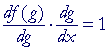
This implies the following:
Theorem. If g(x) is the inverse of f(x), then
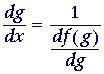
"The derivative of an inverse function is equal to
the reciprocal of the derivative of the direct function
when its argument is the inverse function."
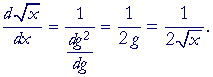
| Example. Let f(x) = x2, and |  |
Then f( g) = g2. |
Therefore,

Next Lesson: Instantaneous velocity and rates of change
Please make a donation to keep TheMathPage online.
Even $1 will help.
Copyright © 2021 Lawrence Spector
Questions or comments?
E-mail: teacher@themathpage.com