
Lesson 29
PERCENT OF A NUMBER
Every statement of percent involves three numbers. For example,
8 is 50% of 16.
8 is called the Amount. 50% is the Percent. 16 is called the Base. The Base always follows "of." What you see above is the standard form of any statement of percent.
The Amount is some Percent of the Base.
In a percent problem, we are given two of those numbers and we are asked to find the third. We have already seen how to solve any percent problem with a calculator. The same procedures apply in a written calculation, in which we would typically change the percent to a decimal.
In Lesson 4 we saw how to take 1% and 10% of a number simply by placing the decimal point. Those should be basic skills. What is more, from 1% we can calculate 2%, 3%, and so on. While from 10% we can easily calculate 20%, 30% and any multiple of 10%.
In Lesson 28 we saw how to solve percent problems by understanding that a percent is a ratio. Here, we will continue those problems -- we will see how to find the Amount with a minimum amount of writing. And in Section 3 we will see how to find the Base.
In this Lesson, we will answer the following:
We begin with the elementary question:
| 1. | How much is any percent of 100? |
| 32% of 100 = ? | |
| Any percent of 100 is that number. | |
32% of 100 is 32. 87.9% of 100 is 87.9. 416% of 100 is 416. For as we saw in Lesson 4, percent is an abbreviation for the Latin per centum, which means for each 100. (Per means for each.) A percent is a number of hundredths.
Example 1. A store paid $100 for a jacket. It then raised the selling price by 28%. But a week later it reduced that price by 10%. What was the final selling price?
Solution. 28% of $100 is $28. So the selling price became $128.
10% of that is $12.80. (Lesson 4.)
To subtract $12.80 from $128, round it off to $13:
$128 − $13 = $115, plus $.20 is $115.20.
That was the final selling price.
| 2. | How can we find 25% or a fourth of a number? |
| Take half of 50%. That is, take half of half. | |
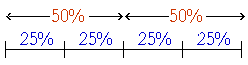
25% is half of 50%.
Compare Lesson 16.
Example 2. How much is 25% of 60?
Answer. Half of 60 is 30. Half of 30 is 15.
Example 3. How much is 25% of 180?
Answer. Half of 180 is 90. Half of 90 is 45.
Example 4. How much is 25% of 112?
Answer. Half of 112 = Half of 100 + Half of 12 = 56.
Answer. Half of 56 = Half of 50 + Half of 6 = 25 + 3 = 28.
Answer. Lesson 16.
Example 5. How much is 25% of $9.60?
Answer. Half of $9.60 = $4.50 + $.30 = $4.80. Half of $4.80 = $2.40
Example 6. Eighths. How much is 37.5% of $600?
Answer. Upon recognizing that 37.5% means three eighths (Lesson 24), this is not a difficult problem.
(The student should know the eighths; they come up frequently.)
First, a quarter of $600 is half of $300: $150. And an eighth is half of a quarter: $75. Therefore three eighths are three times $75: $225.
Equivalently, one quarter -- $150 -- is two eighths. Therefore, three eighths will be one quarter plus half of one quarter: $150 + $75 = $225.
| 3. | How can we find 15%? |
| Take 10% and add half. | |
Example 7. How much is 15% of $70??
| Answer. 15% | = | 10% + Half of 10% |
| = | $7.00 + $3.50 | |
| = | $10.50. | |
See Lesson 4, Question 7: How can we take 10%?
Example 8. If you tip at the rate of 15%, and the bill is $40, how much do you leave?
| Answer. 15% | = | 10% + Half of 10% |
| = | $4.00 + $2.00 | |
| = | $6.00. | |
In general:
| 4. |
How can we find the Amount when we know the Base and the Percent? |
| Amount = Base × Percent or Percent × Base | |
We saw this in Lesson 10 and in Lesson 14.
Example 9. Percent to a decimal. How much is 11% of $420?
Solution 1. 11% is 11 hundredths, which we can represent as the decimal .11. Therefore,
11% of $420 = .11 × 420.
(Lesson 27.) Now,
11 × 420 = 4200 + 420 = 4620. (Lesson 9)
Therefore, on separating two decimal digits (Lesson 10),
11% of $420 = $46.20.
(Compare Lesson 10, Question 4.)
Solution 2. More simply, since 11% = 10% + 1%, then
| 11% of $420 | = | $42 + $4.20 (Lesson 4, Questions 6 and 7) |
| = | $46.20. |
Example 10. How much is 30% of $48?
Solution. The student should realize that 30% is simply three times 10% and so will always involve multiplication by 3. (Its decimal is .3.)
Now, 10% of $48 is $4.80. Therefore, 30% is
| 3 × $4.80 | = | 3 × $4 + 3 × $.80 |
| = | $12 + $2.40 (Lesson 9) | |
| = | $14.40. | |
See Lesson 9, The distributive property of multiplication, Examples 5 and 6.
Example 11. How much is 40% of $90?
Solution 1. 4 times 9 is 36. 40% of $90 is $36.
Solution 2. 10% of $90 is $9. Therefore 40% is 4 times $9: $36.
Example 12. Vanessa is about to withdraw $3000 from her retirement account. But 20% will be withheld for taxes. How much will she actually receive?
Solution. Since 20% will be withheld, she will receive 80%. (The whole is 100%.) 80% of $3000 is
.8 × 3000 = 2400.
(Lesson 10. The 0 of .80 is unnecessary. Lesson 3.)
She will receive $2400.
Example 13. How much is 80% of $45?
Solution 1. If we multiplied by .8, the answer would have one decimal digit.
| .8 × 45 | = | 45 × .8 |
| = | 4.5 × 8. | |
For it is easy to do 4.5 × 8, that is -- Four and a half times 8.
"Four times 8 is 32. Half of 8 is 4. 32 plus 4 is 36."
80% of $45 is $36.
(Compare Lesson 27, Multiplying by numbers ending in 5.)
Solution 2. 80% means four fifths; 45 has an exact fifth part. Therefore we can reason as follows:
One fifth of 45 is 9. Therefore four fifths are four 9's -- 36.
Example 14. How much is 75% of 108?
Answer. We could write 75% as the decimal .75, and then multiply
.75 × 108.
However, 75% is three quarters. Therefore we could calculate
Three quarters of 108.
That is not difficult if we decompose 108 into 100 + 8.
| Three quarters of 108 | = | Three quarters of 100 + Three quarters of 8 | |
| = | 75 + 6 | (Lesson 15) | |
| = | 81. | ||
75% of 108 is 81.
Example 15. How much is 18.9% of $314?
Answer. Use your calculator Press 314 × 18.9%. See 59.346, which is approximately $59.35.
To do a problem in writing, then, we must express the percent either as a decimal or a fraction. As for expressing a percent as a fraction:
| 5. | How can we represent a percent as a fraction? |
| 29% = ? | |
|
We can represent a percent as a fraction whose denominator is 100. That will sometimes lead to a whole number or a mixed number. |
|
Examples 16.
| 29% | = | 29 100 |
. | ||||
| 60% | = | 60 100 |
= | 6 10 |
= | 3 5 |
. (Lesson 22, Question 5) |
| 200% | = | 200 100 |
= 2. | ||||
| 250% | = | 200% + 50% = 2½. |
| 225% | = | 2¼. |
| 233 | 1 3 |
% = 2 | 1 3 |
. |
In addition, the student should know:
| 12.5% | = | 1 8 |
. ( | 1 8 |
is half of | 1 4 |
, which is 25%. ) |
| Lesson 24 | |||||||
| 37.5% | = | 3 8 |
, 62.5% = | 5 8 |
, 87.5% = | 7 8 |
. |
Example 17. How much is 250% of 32?
Answer. 250% = 2½.
| 2½ × 32 | = | 2 × 32 + ½ × 32 |
| "Two times 32 + Half of 32" | ||
| 2½ × 32 | = 64 + 16 |
| 2½ × 32 | = 80. |
Example 18. How much is 37½% of $40?
| Answer. 37½% = | 3 8 |
. (Lesson 24).) One eighth of $40 is $5. |
Therefore, three eighths are 3 × $5 = $15.
| Example 19. Thirds. | How much is 33 | 1 3 |
% of 720? |
| How much is 66 | 2 3 |
%? | |
| Answer. 33 | 1 3 |
% means a third. (Lesson 16.) To take a third |
of 720, we can decompose it into multiples of 3 as follows:
720 = 600 + 120.
A third of 600 is 200.
A third of 120 is 40.
Therefore a third of 720 is 240.
| As for 66 | 2 3 |
%, it means two thirds. One third of 720 |
is 240.
Therefore two thirds are 2 × 240 = 480.
| Example 20. Calculator problem. How much is 66 | 2 3 |
% |
of $76.27?
Solution. To find two thirds, we must first find one third, and then multiply by 2. Press
| 7 | 6 | . | 2 | 7 | ÷ | 3 | = | × | 2 | = |
See
| 50.846666666 |
This is approximately $50.85.
The standard textbook method for finding a percent of a number, has been to change the percent to a decimal and multiply. And so to find 24% of $412, we are taught to change 24% to the decimal .24 (Lesson 4), and multiply times 412.
But is anyone with a calculator going to do that these days? And aren't there more important things to learn about percent? Like how to take 25% of $412 without writing anything! Take half of 50%, which is $206. 25% is $103.
24% of $412 will then be 25% − 1%:
| 103 − 4.12 | = | 103 − 3 − 1 − .12 |
| = | 100 − 1 − .12 | |
| = | 99 − .12 | |
| = | $98.88. | |
| Example 21. 14 is 66 | 2 3 |
% of what number? |
Answer. Here, the Base is missing, the number that follows of. This is Example 2 in Section 3.
At this point, please "turn" the page and do some Problems.
or
Continue on to the Section 2: Fractional percent
Introduction | Home | Table of Contents
Copyright © 2021 Lawrence Spector
Questions or comments?
E-mail: teacher@themathpage.com